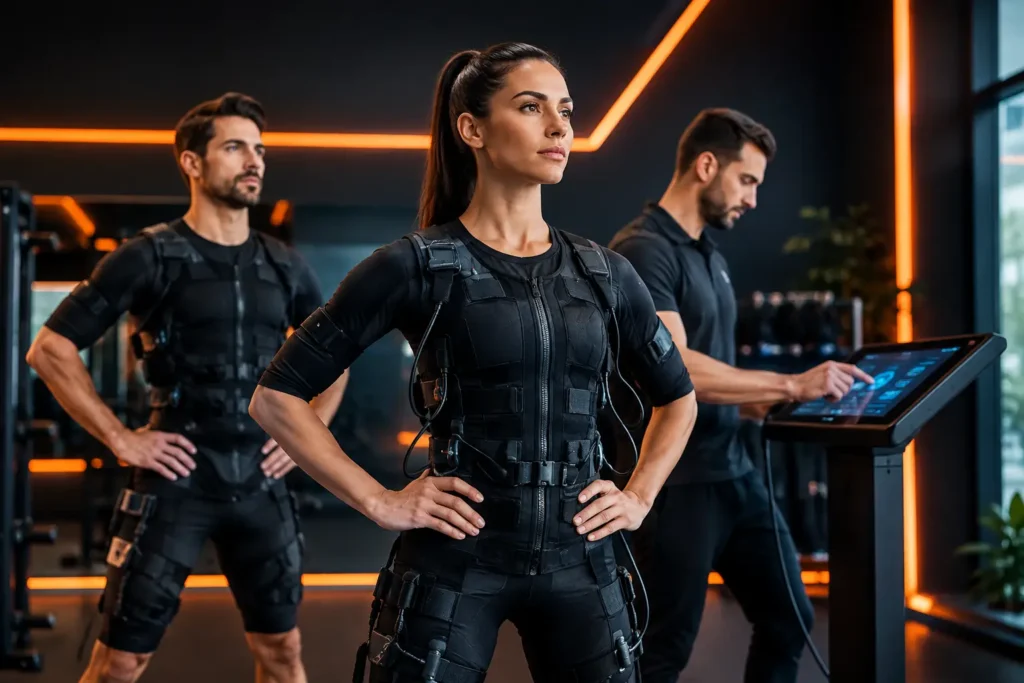


The wrong EMS setup usually does not fail because demand is weak. It fails because the operator chose a model that does not match their capital, schedule, market, or pricing power. That is why an EMS business model comparison matters early. If you are deciding between a mobile service, a fixed studio, or a premium dry wireless concept, the best choice is the one that fits how you plan to sell, deliver, and scale.
This is not just a question of equipment. It is a question of operating model. How many sessions can you deliver per day? Do you want low overhead or higher throughput? Are you selling convenience, transformation, or exclusivity? Each EMS format can be profitable, but the economics look very different once you factor in acquisition costs, staffing, utilization, and client retention.
The three EMS models that matter most
For most operators, the real decision comes down to three commercial formats. Mobile EMS is built for low initial investment and fast market entry. Studio EMS is designed for consistent delivery, stronger brand presence, and higher session volume. Premium dry wireless EMS targets boutique wellness, luxury, and high-ticket personal service environments where experience and pricing power matter as much as training outcomes.
A lot of first-time operators assume the lowest-investment route is automatically the safest. Sometimes it is. But low investment can also mean lower daily capacity and more dependence on the founder’s personal time. On the other side, a larger studio setup can produce stronger monthly revenue, but only if local demand, pricing, and operations are managed well. Premium concepts sit in a different lane. They usually rely on a narrower audience, but they can produce attractive margins when the brand positioning is strong.
EMS business model comparison by investment and risk
Mobile EMS is usually the simplest commercial entry point. You can launch with less space cost, fewer fixed overheads, and a more flexible service area. For solo personal trainers, wellness coaches, and early-stage entrepreneurs, that matters. You are not committing to rent, front-desk staffing, or a fully built-out location before you validate demand. The trade-off is that your business is tied closely to your own availability. Travel time reduces capacity, and local logistics shape your day more than in a fixed-site model.
Studio EMS requires more commitment up front. You need a suitable location, a stronger operating plan, and often a clearer client acquisition system from day one. In return, you gain scheduling control, more consistent service delivery, and better conditions for scaling with staff. If your goal is to build an asset rather than stay self-employed, this model often makes more sense. It creates room for recurring memberships, higher weekly session density, and a more visible brand in your market.
Premium dry wireless EMS sits higher on the investment and branding spectrum. The value is not only in the training system but in the client experience. This model suits boutique studios, longevity concepts, luxury wellness spaces, clinics, and VIP personal service businesses. It can support premium pricing, but it also demands a premium environment and a client journey that feels intentional from first contact to retention. If your local market is price-sensitive and transactional, this model may be harder to fill consistently.
Revenue potential depends on capacity, not hype
Operators often compare models by equipment price first. That is understandable, but incomplete. Revenue potential comes from how many sessions you can sell, at what price, and with what level of repeat behavior.
A mobile EMS business can produce healthy revenue with relatively low overhead, especially when the operator has a strong personal brand or an existing client base. If you already work with private clients, corporate wellness groups, or rehabilitation referrals, mobile delivery can convert quickly. But your ceiling is lower unless you add trainers or reorganize your offer around efficient route planning and clustered appointments.
Studio EMS has a different profile. It usually offers better weekly session density, stronger routine, and easier rescheduling. Clients know where to go, staff work in one place, and the business can support more appointments per day. That means higher top-line potential. It also means you need the marketing engine to keep the schedule full. Empty hours in a studio are more expensive than free hours in a mobile model.
Premium dry wireless EMS tends to generate revenue through higher ticket value rather than pure volume. The commercial logic is simple: fewer clients, stronger pricing, better experience, and often better cross-sell potential into recovery, wellness, aesthetics, or longevity services. This can be very profitable, but only when your market sees the offer as premium and not just different.
Which model fits your client acquisition reality?
This is where many decisions become clearer. If you already have direct access to clients through personal training, physiotherapy, wellness consulting, or a local network, mobile EMS can be the fastest way to monetize that access. You do not need to wait for a full facility launch to start selling.
If your strategy depends on walk-ins, local visibility, or a branded destination business, studio EMS is usually the better fit. A fixed site gives people a place to remember, recommend, and revisit. It also supports social proof more effectively because the business feels established.
If your client acquisition comes from premium referrals, concierge relationships, luxury partnerships, or founder-led positioning, a premium dry wireless model can work extremely well. The offer is not mass-market. It is designed for clients who value privacy, design, convenience, and innovation enough to pay more for them.
Operations decide whether the model stays profitable
A smart EMS business model comparison should always include operational burden. Mobile looks light on paper, but travel, setup, transport, and scheduling gaps can eat into margin if they are not managed carefully. You are buying flexibility, but also taking on movement and time inefficiency.
Studio operations are more predictable. Equipment stays in place, the client journey is standardized, and team training is easier to control. That consistency supports quality and scale. Still, fixed overhead means you need enough bookings to keep the model efficient.
Premium concepts require the most discipline around experience. The training itself is only part of the product. Presentation, hospitality, atmosphere, and service consistency all affect retention and pricing. If the delivery feels ordinary, the premium disappears fast.
A practical way to choose the right EMS model
Start with your real constraints, not your ideal future brand. If you want to enter the market quickly with limited capital and hands-on delivery, mobile EMS is usually the strongest starting point. It gives you speed, lower risk, and a direct path to first revenue.
If you already run a gym, clinic, or wellness facility and want to add a scalable EMS revenue stream, studio EMS is often the more commercially efficient move. It fits businesses that already understand appointment flow, member retention, and staff utilization.
If your business is built around premium positioning, luxury service, or high-value clientele, dry wireless EMS deserves serious consideration. It creates a stronger experience-led offer and can support better pricing, but only if the rest of the business is positioned at the same level.
There is also a staged path that many operators overlook. You do not always need to choose one model forever. Some businesses start mobile to validate pricing and demand, then transition into a studio once client volume is stable. Others begin with a studio and later introduce premium dry wireless services to move upmarket. The strongest decision is often the one that matches your current stage while leaving room for your next one.
Where support changes the economics
The model itself matters, but execution matters more. Financing flexibility, onboarding, business planning, staff training, warranty coverage, and spare parts all affect launch speed and downtime risk. For operators entering EMS for the first time, those factors can shorten the path to revenue more than a small difference in hardware cost.
That is why serious buyers look beyond the machine. They look at how fast they can launch, how confidently they can sell, and how well they can keep operating when issues come up. A partnership-led provider such as EMS Leader is built around that logic: helping operators match the right format to their investment level, market position, and growth plan rather than pushing a one-size-fits-all setup.
The best EMS business model comparison is not about finding a universally better option. It is about finding the model that gives you the clearest path to occupancy, margin, and repeat business in your market. Start with the economics you can actually support, then build toward the concept you want to own.