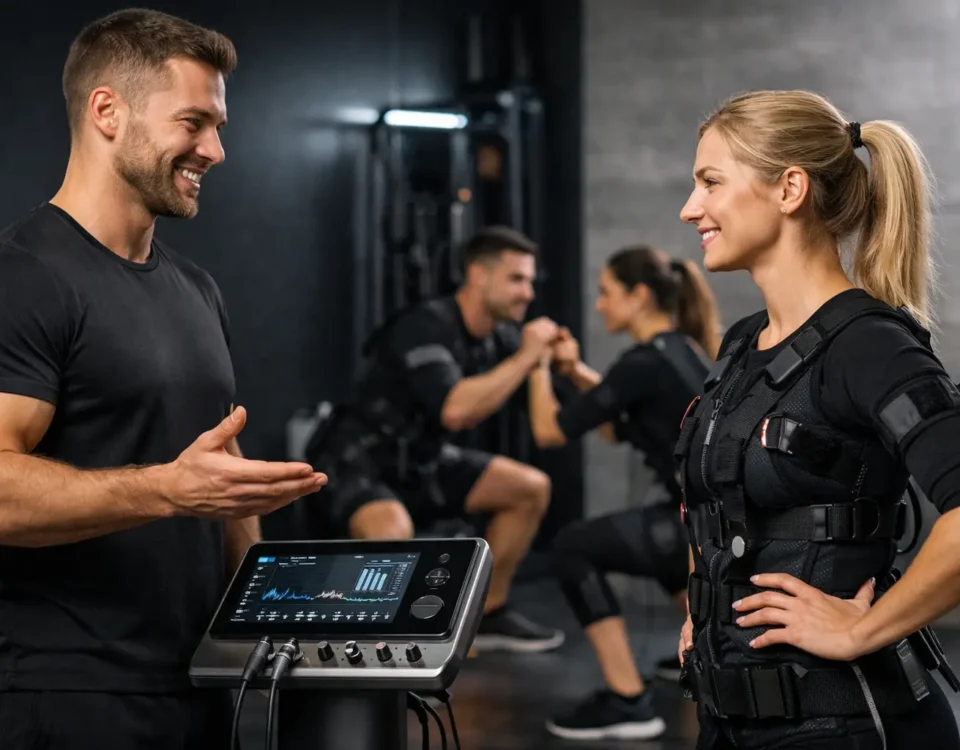


An EMS studio can look simple from the outside: a compact space, appointments, trained coaches, and a premium service. The commercial reality is more demanding. If you are researching how to launch an EMS studio, the strongest starting point is not choosing equipment. It is defining a business model that matches your capital, client profile, local demand, and capacity to sell recurring training.
EMS works best as a focused service with a clear operating system. That means knowing who you will serve, what each session is worth, how many clients each coach can support, and what happens after a prospect completes their first trial.
Start With the EMS Studio Model
Before signing a lease or comparing systems, decide what kind of EMS business you are building. A studio designed for high-volume semi-private sessions needs different space, staffing, and equipment capacity than a premium one-to-one wellness concept.
For many operators, the most practical studio model is appointment-based training with one coach managing a small number of clients per session. This creates efficiency without making the service feel impersonal. It can work well for trainers moving beyond hourly personal training, gym owners adding a high-value service, and clinic or wellness operators creating a structured training offer.
Your model should answer four commercial questions: Who is the ideal client? How many clients can train at one time? Will you sell memberships, session packages, or a hybrid? What monthly revenue must the studio generate to cover fixed costs and produce a worthwhile return?
| Studio approach | Best fit | Main commercial advantage | Key consideration | | — | — | — | — | | One-to-one EMS | Personal trainers and premium concepts | Strong personalization and higher service positioning | Coach time limits daily capacity | | Small-group EMS | Dedicated studios and gyms | More clients per coaching hour | Requires consistent scheduling and group management | | EMS within an existing facility | Gyms, clinics, and wellness centers | Uses an established client base and rent structure | Needs clear internal sales ownership | | Premium dry wireless EMS | Boutique wellness and VIP concepts | Distinctive experience and flexible presentation | Requires a market willing to pay for premium service |
There is no universally best option. A new operator with a modest client base may benefit from starting lean and proving demand. An established gym may be ready to introduce multiple stations and use its membership database for conversion. The right setup is the one your sales capacity and operating budget can support from day one.
Build the Numbers Before You Build the Studio
A profitable EMS studio is planned from the unit economics upward. Avoid selecting a location, then hoping the revenue model works. Instead, calculate the number of active clients needed to reach break-even and the number needed to create a healthy operating margin.
Start with your fixed monthly costs: rent, payroll, equipment financing or rental, utilities, insurance, software, marketing, cleaning, and supplies. Then estimate the revenue per active client based on your intended package structure. If clients attend regularly, recurring memberships can improve cash-flow visibility. Packages may be easier to introduce in markets where clients want flexibility. Many studios use both: an introductory package that moves into a recurring plan.
Next, test your capacity. If a coach can deliver a set number of sessions per day, and each session has a defined number of training positions, what does realistic utilization look like at 40%, 60%, and 80% occupancy? The 80% case can be encouraging, but your launch plan should survive at a more conservative level.
Do not overlook the cost of client acquisition. A polished studio can still underperform if it depends on constant discounts to fill appointments. Build an offer that communicates value: time efficiency, coached sessions, measurable progression, and a premium training environment. Your first goal is not maximum volume. It is a repeatable conversion process from inquiry to trial to retained client.
Choose a Location That Supports the Sale
An EMS studio does not always require a large footprint, but it does require the right context. Visibility can help, especially for consumer discovery, yet a highly visible address with excessive rent may weaken the business case. Studios can also perform well in wellness districts, residential areas with the right demographic, premium office zones, or inside an established gym or clinic.
Evaluate access before aesthetics. Is parking available? Can clients arrive before or after work? Is the studio easy to find? Is there enough privacy for consultations and changing? A smaller, well-organized location with reliable access often performs better than a larger space that creates unnecessary overhead.
Plan the client journey through the space. You need a professional reception or consultation point, training area, changing facilities where appropriate, storage for garments and accessories, and a clear cleaning workflow. The environment should reinforce the price point. It does not need to be extravagant, but it must feel controlled, clean, and credible.
Select Equipment and Support as a Business Decision
Equipment is central to the service, but the purchase decision should extend beyond technical specifications. Consider system capacity, durability, ease of daily use, training requirements, warranty coverage, spare-parts access, and the support available when your studio is operating with booked clients.
Financing structure matters as much as the system itself. Direct purchase may suit operators with available capital who want long-term ownership. Rental or rent-to-own can preserve working capital for launch marketing, rent deposits, staffing, and the first months of operations. The best route depends on your cash position and the speed at which you expect to build active membership.
A supplier should also help you pressure-test the model. EMS Leader supports operators with equipment access, setup guidance, training, warranty coverage, spare parts, and business consultation because a studio launch is not solved by delivery alone. The value of support becomes especially clear when you are setting up protocols, training staff, or resolving an operational issue between appointments.
Train for Safety, Consistency, and Retention
Clients return when the experience is professional, well coached, and consistent. That requires more than learning how to operate a device. Your team needs a structured approach to consultation, screening, session delivery, intensity management, hygiene, documentation, and client progression.
Create a standard onboarding process before opening. Every client should know what to expect, how often to train, how sessions are structured, and how progress will be reviewed. Coaches should use the same language around suitability and training expectations while still adapting sessions to the individual.
Avoid making claims that your service cannot responsibly support. Position EMS as coached training within a well-managed fitness or wellness program, not as a shortcut or a medical solution. Clear communication protects your reputation and creates better-fit clients.
Launch Sales Before Opening Day
Do not wait until the studio is complete to start generating demand. Your pre-launch period is where you build a lead list, arrange consultations, and test which messages produce qualified interest. Existing trainers and gym owners have an advantage here: former clients, current members, and local professional networks can provide the first audience.
Your launch campaign should be simple and specific. Offer a limited number of founding memberships or assessment appointments, explain the session format, and make booking easy. Avoid vague promises about dramatic results. Prospects respond better to a confident explanation of the service, the coaching process, and the convenience of a structured appointment.
Sales follow-up is where many launches lose momentum. Assign responsibility for responding to inquiries quickly, confirming appointments, following up after trials, and asking for the sale. Track the numbers weekly: leads, booked consultations, show-up rate, trial-to-member conversion, average revenue per client, and cancellations. These metrics reveal whether the issue is demand, sales process, pricing, or client experience.
How to Launch an EMS Studio Without Overbuilding
The most common strategic mistake is spending heavily on design, rent, and equipment capacity before validating the sales engine. A refined studio is valuable, but it cannot compensate for unclear positioning or weak retention.
Launch with a controlled operating plan. Set your initial hours around likely demand, staff according to booked sessions rather than optimism, and reserve cash for marketing and operating expenses. If demand grows, add sessions, coaches, and capacity from a position of evidence rather than pressure.
At the same time, do not underinvest in the fundamentals. Professional equipment, trained staff, reliable support, and a clean client environment are not optional shortcuts. They are the operating foundation that allows you to charge appropriately and keep clients confident in the service.
The studio that gains traction is rarely the one with the biggest opening. It is the one that makes every early client feel well guided, converts that experience into recurring revenue, and builds capacity only when the numbers justify the next move.