

A poorly qualified lead can cost far more than a missed session. It can create an unsafe training situation, damage trust, disrupt your schedule, and expose your business to avoidable risk. Knowing how to screen EMS clients is therefore not an administrative task. It is a core operating system for any serious mobile EMS service, studio, gym, or wellness concept.
A strong screening process helps you identify who is appropriate for EMS training, who needs additional medical clearance, and who should not proceed. It also creates a more professional client experience. The right client feels that your business has standards, understands their goals, and takes their safety seriously.
How to Screen EMS Clients With a Repeatable Process
The best screening systems are consistent, simple to administer, and documented. They should happen before the first active EMS session, not in the few rushed minutes after a client arrives.
Build your process around four stages: a pre-session questionnaire, a trainer-led consultation, informed consent, and a final readiness check on the day of training. Each stage has a different purpose. Together, they give you a clear decision: proceed, proceed with modifications, request clearance, or decline the session.
Start with a pre-session health questionnaire
Send a confidential intake form when a prospect books or purchases a trial. This protects your schedule because it identifies obvious concerns before you reserve coaching time or prepare equipment.
The form should gather basic contact details, emergency contact information, current activity level, training history, and the client’s stated goals. It should also ask clear health questions relevant to electrical muscle stimulation. Avoid vague wording. A client should be able to understand and answer each question without guessing.
Your questionnaire should flag conditions, devices, symptoms, medications, recent procedures, and other circumstances that may affect suitability for EMS. The exact content of your form should be reviewed against local rules, your equipment instructions, your insurance requirements, and the guidance provided in your professional training.
Do not treat an online form as a clinical diagnosis. Its purpose is to identify risk factors and trigger the right next step. If a response raises concern, pause the onboarding process and request appropriate medical clearance or advise the person to consult a qualified healthcare professional.
Use the consultation to verify, not just sell
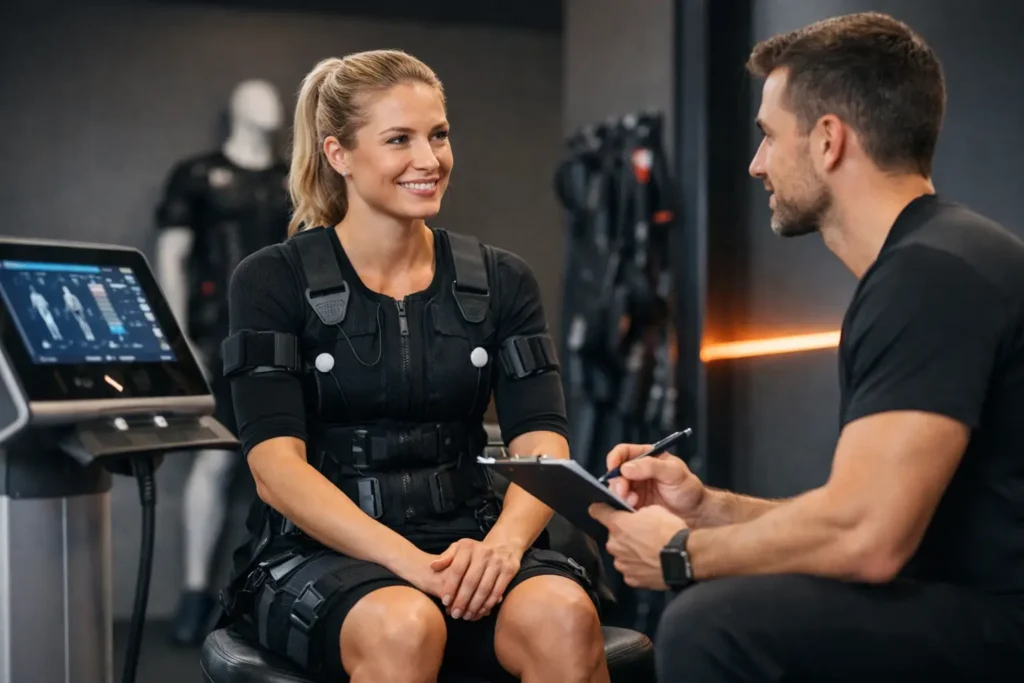
A form alone is not enough. Schedule a brief consultation before the first session, in person or by video when appropriate. This is where an EMS coach confirms the answers, clarifies goals, and evaluates whether the client understands what EMS training involves.
Ask what result the client wants from the service. Some may want structured strength training with time efficiency. Others may be returning to exercise after a long break, complementing an existing fitness routine, or looking for a premium one-to-one service. Their goal affects programming, frequency expectations, and the level of coaching required.
Also ask about previous exercise experience. A highly trained athlete and a sedentary first-time exerciser may both be eligible, but they should not receive the same first-session intensity or progression plan. Screening is not only about exclusion. It is about matching the starting point to the person in front of you.
Use direct questions to confirm any health-related answers that were unclear or incomplete. Keep your language professional and neutral. You are not trying to persuade a client to minimize a concern so they can buy a package. A qualified client who begins with confidence is more valuable than a rushed sale that creates a problem later.
Identify Red Flags and Make a Clear Decision
Your staff should never have to improvise when a screening response raises concern. Create a written internal policy that classifies client outcomes into four categories.
- Approved to begin: The client has completed the intake, has no relevant restrictions, understands the service, and can start with an appropriate introductory protocol.
- Approved with modifications: The client can train, but the coach should adjust exercise selection, positioning, intensity, session duration, or progression based on the intake conversation.
- Medical clearance required: The client reports a factor that requires review by a qualified healthcare professional before participation. Do not make the clearance decision based on sales pressure or assumptions.
- Not appropriate for your service: The client has a stated contraindication, is unwilling to complete screening, cannot provide required clearance, or presents a risk that your business is not equipped to manage.
This framework makes decisions faster and more consistent across coaches. It is especially valuable when you operate a multi-trainer studio, work across several locations, or offer mobile EMS appointments where staff work independently.
Certain issues may require particular attention, including implanted electronic devices, pregnancy, acute illness, unexplained pain, recent surgery, active medical treatment, neurological concerns, and cardiovascular history. This is not a complete list, and it should never replace your formal equipment protocols or medical guidance. The operational principle is straightforward: when there is uncertainty, stop and escalate rather than guessing.
A client who needs clearance is not necessarily a lost client. Explain the process respectfully: you want to make sure the planned service is appropriate and that their program starts under the right conditions. This protects the relationship while maintaining professional boundaries.
Document consent and set realistic expectations
Once a client is cleared to proceed, use an informed consent process. The consent document should explain the nature of EMS training, the sensations the client may experience, the importance of communicating discomfort, and the circumstances in which the session may be stopped or adjusted.
Consent should be specific, voluntary, and signed before training begins. It should not be buried inside a generic membership agreement. Give clients time to read it and ask questions.
This is also the moment to set expectations about training frequency, recovery, hydration, coaching cues, and progression. EMS is not a shortcut that removes the need for sound programming, client effort, or responsible recovery habits. Position it as a coached training service with a structured progression plan.
For a business, expectation-setting supports retention. Clients who understand why their first sessions are controlled and progressive are less likely to judge the service by an unrealistic first-day outcome. They are more likely to value coaching quality, consistency, and measurable progress over time.
Make the First Session a Second Screening Point
Even a well-designed intake cannot capture every change in a client’s condition. The first session should begin with a short verbal check-in. Ask whether anything has changed since the consultation, whether they feel unwell, have new pain, started new medication, or have had a recent procedure or health event.
This takes less than two minutes and reinforces that screening is ongoing. Repeat the check-in before every session, using a brief version that is easy for staff to document. A client who was suitable last month may not be ready today.
During the first active session, start conservatively. Confirm comfort and understanding before increasing intensity. Watch how the client responds to basic movements, coaching instructions, and the stimulation sensation. The goal is not to demonstrate maximum output. The goal is to establish a safe baseline that makes the next session easier to program.
This approach is commercially smart as well as responsible. Clients remember whether they felt guided. A controlled first experience helps reduce anxiety, supports referrals, and gives your team better information for a tailored plan.
Train Your Team to Deliver the Same Standard
A screening process is only as reliable as the people using it. Every coach should know which questions to ask, how to identify an incomplete response, when to stop a session, and who has authority to make escalation decisions.
Create simple operating documents: the intake form, a clearance request procedure, consent records, a session check-in template, and an incident reporting process. Store sensitive information securely and limit access to staff who genuinely need it. Privacy is part of professionalism, particularly when clients share health information.
For growing EMS businesses, standardization has another advantage: it makes expansion easier. Whether you run a mobile one-to-one model or a multi-station studio, documented screening reduces dependence on one experienced operator. New coaches can be trained into the same client qualification standard, and managers can audit whether procedures are being followed.
EMS Leader supports operators with training and operational guidance because equipment performance and business performance both depend on qualified delivery. The system you build around the device matters as much as the device itself.
Turn Screening Into a Better Client Journey
Do not present screening as a barrier between a prospect and a sale. Present it as evidence that your service is structured. The client is not buying random stimulation. They are entering a coached program designed around their readiness, goals, and progression.
Keep the process efficient. A short digital intake before booking, a focused consultation, clear consent, and a routine readiness check are usually enough for eligible clients. If your process is too complicated for low-risk clients, conversion can suffer. If it is too casual for higher-risk clients, your business takes on unnecessary exposure. The right balance depends on your market, staff qualifications, service model, and local requirements.
A disciplined screening process gives you permission to grow with confidence. It protects your coaches, improves client communication, and helps ensure that every session starts with the right decision: not simply whether someone can train, but whether your business can deliver the right session for them today.