
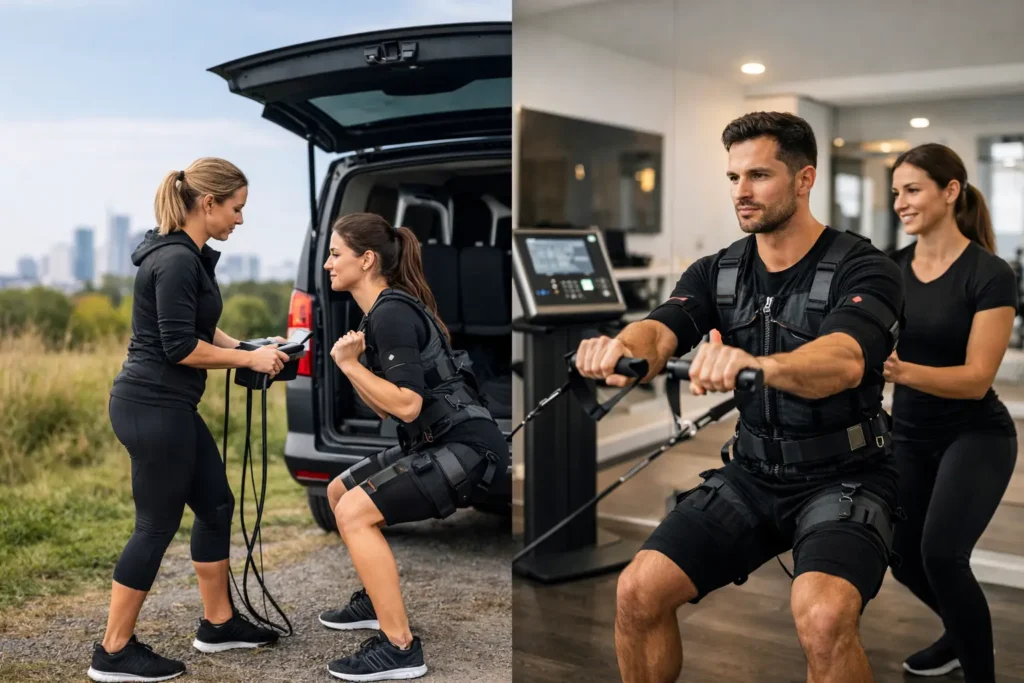
A personal trainer with a strong client base can start generating EMS revenue without signing a lease. A gym owner may already have the floor traffic to support multiple sessions per hour. That difference is the real starting point for the mobile EMS vs studio decision. The better model is not the one that looks bigger on paper. It is the one that matches your capital, sales pipeline, operating capacity, and growth plan.
For many operators, mobile EMS is the fastest route to market. Studio EMS creates a more scalable service environment once demand is proven. Both can be commercially strong, but they require different levels of discipline and deliver value in different ways.
Mobile EMS vs Studio: The Core Business Difference
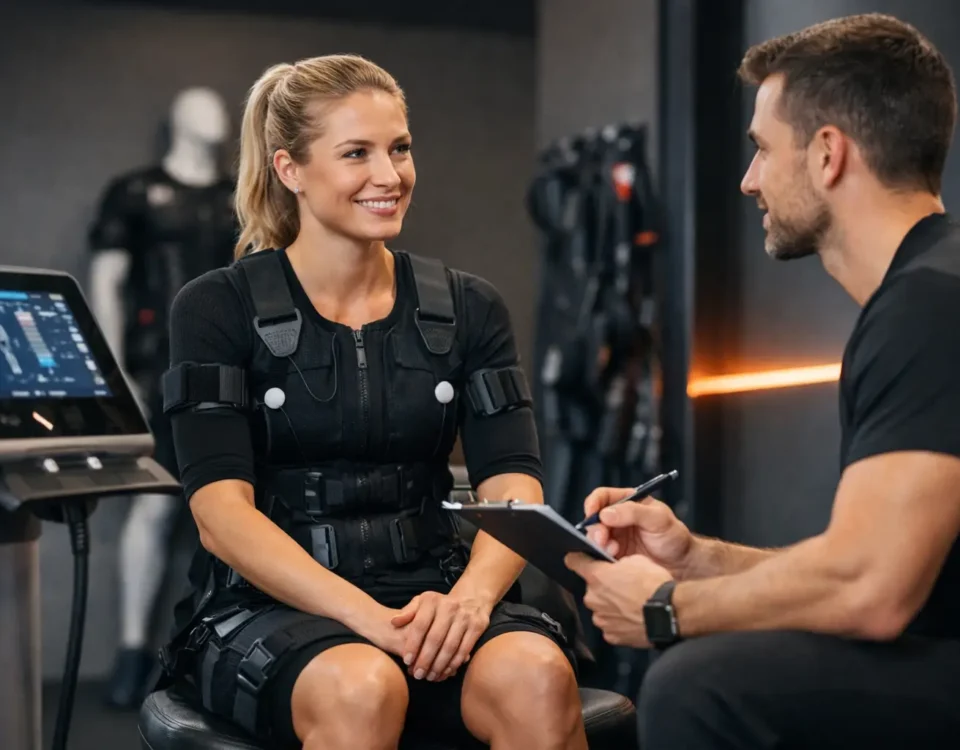
Mobile EMS is a low-overhead, service-led business model. The operator takes a portable EMS system to the client, trains clients at their home or workplace, or uses rented space inside a partner gym, clinic, hotel, or wellness center. It is typically built around one-to-one coaching and a highly personal client relationship.
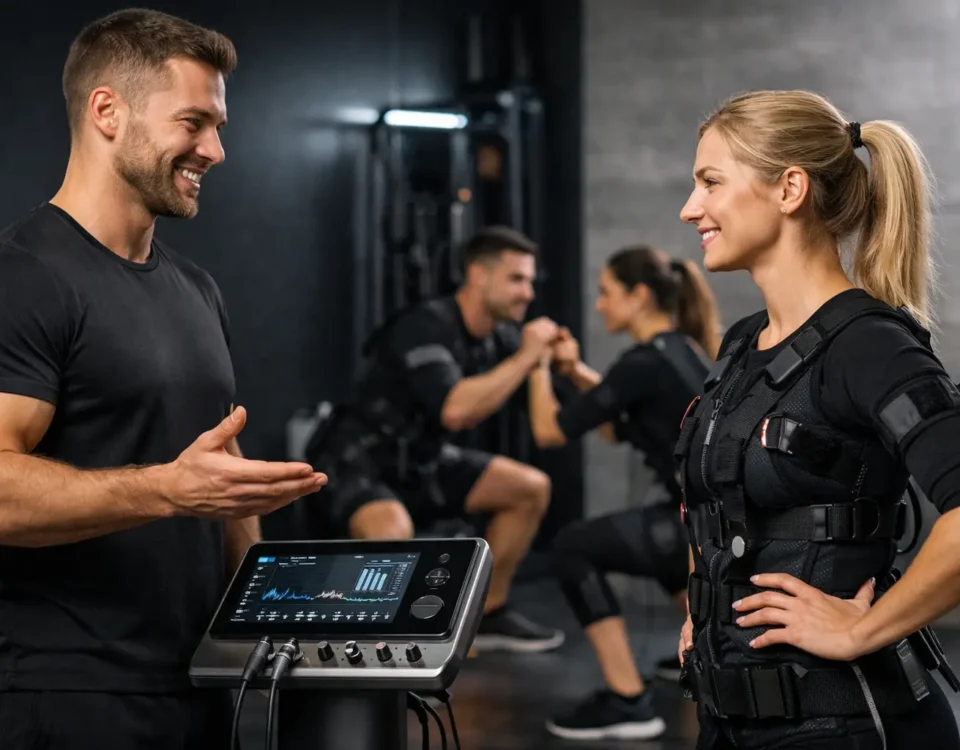
Studio EMS is a location-led model. Clients come to a dedicated facility or a defined EMS area within an existing gym, clinic, or wellness concept. The setup can support more consistent scheduling, staff delivery, stronger local visibility, and potentially higher session volume.
The commercial trade-off is straightforward. Mobile EMS reduces fixed costs and allows a faster launch, but the founder’s time, travel radius, and personal availability can limit capacity. A studio demands more upfront planning and operating expense, but it can create a business that is less dependent on one trainer.
Start With Investment and Fixed Costs
Capital exposure should shape the decision early. A mobile operator usually needs EMS equipment, training, insurance, transport, client management tools, and a practical way to market locally. There is no requirement to fit out a permanent facility, buy reception furniture, or carry a long-term commercial lease before the first client is signed.
That makes mobile EMS particularly suitable for personal trainers, wellness professionals, and first-time EMS entrepreneurs who want to validate demand with controlled risk. Rental or rent-to-own equipment can further preserve working capital while the client base is developing.
A studio requires a wider budget. Beyond the EMS system, operators should plan for the location, deposits, utilities, changing space, interiors, staffing, booking systems, cleaning procedures, signage, and local lead generation. If EMS is added to an existing gym or clinic, some of these costs may already be covered. That can make a studio-style rollout far more attractive than opening a standalone site from zero.
The key question is not simply, “Can I afford a studio?” Ask whether your expected recurring revenue can comfortably cover fixed costs during slower months. A studio can be a strong asset, but only when the local market and your sales process can support it.
Capacity, Scheduling, and Revenue Structure
Mobile EMS is usually designed around premium, appointment-based service. You can build a schedule around a smaller number of clients, deliver personalized coaching, and package EMS into a broader personal training or wellness offer. This is especially useful where convenience is a clear differentiator: executives, private residential clients, hotel guests, or clients who prefer individual attention.
The challenge is productive time. A 20-minute session may require substantially more than 20 minutes once travel, setup, packing, and schedule gaps are included. A mobile business needs thoughtful route planning, defined service zones, and pricing that reflects convenience rather than only training time.
Studio EMS creates more control over the day. Clients arrive at one address, equipment is ready, and trainers can move through a more predictable timetable. With the right equipment configuration and trained staff, the operator can schedule consecutive appointments or small-format sessions. That improves utilization and gives the business more room to scale.
A studio also makes it easier to build recurring membership structures, introductory programs, and add-on services. However, higher capacity is valuable only if it is filled. An empty schedule in a polished studio is still a fixed-cost problem.
| Business factor | Mobile EMS | Studio EMS | |—|—|—| | Initial investment | Lower and more flexible | Higher, especially for a standalone site | | Speed to launch | Fast once training and equipment are in place | Slower due to site preparation and operations | | Client experience | Private, convenient, highly personalized | Consistent, branded, facility-based | | Daily capacity | Limited by travel and trainer availability | Higher with organized scheduling and staff | | Main growth lever | Premium service, referrals, partnerships | Utilization, memberships, team expansion | | Primary risk | Underpricing travel and founder dependency | Fixed costs outpacing client acquisition |
Client Acquisition Looks Different in Each Model
Mobile EMS businesses often win through relationships. Existing PT clients, referrals, corporate wellness contacts, residential communities, and partnerships with complementary professionals can create a focused pipeline. Your message should be clear: you are bringing a coached EMS service to the client, not simply renting out equipment.
This model is well suited to operators who are confident selling their own expertise. People buy consistency, coaching quality, convenience, and accountability. That means the trainer is central to the commercial offer.
Studio EMS relies more heavily on local visibility and repeatable lead flow. Walk-in exposure, neighborhood searches, social proof, referral programs, partner businesses, and introductory consultations can all support client acquisition. A clear studio identity helps prospects understand what they are booking and why the service is different from a conventional gym session.
For a gym owner, the studio model can be less about building a new audience and more about increasing value from the audience already present. EMS can become a premium personal-training pathway, a time-efficient service category, or a differentiated option within a broader membership ecosystem.
When Mobile EMS Is the Smarter First Move
Mobile EMS is often the practical choice when you are entering the market without an established location, have strong coaching skills, and want to protect cash flow. It also works well when your target clients value privacy and convenience enough to pay for a premium service experience.
It is not a lesser version of a studio. It is a distinct business model with its own strengths. A disciplined mobile operator can build a valuable book of recurring clients, develop local authority, and learn which audience segments convert best before expanding.
Mobile becomes less efficient when travel starts consuming too much of the day, clients are concentrated in one area, or demand regularly exceeds what one trainer can deliver. At that point, a fixed location, shared facility arrangement, or hybrid model may create better economics.
When a Studio Creates More Long-Term Value
A studio is the better fit when you have a proven local audience, access to a suitable location, and a plan to keep appointments flowing beyond the founder’s own diary. It is also a strong option for clinics, gyms, and wellness centers that can integrate EMS into existing operations.
The larger opportunity is operational leverage. A defined site can support staff training, standardized service delivery, stronger branding, and more predictable client routines. Instead of selling only your personal hours, you begin building systems that others can deliver.
That shift requires management capability. You need sales tracking, trainer standards, client retention processes, equipment maintenance routines, and clear operating procedures. Studio growth is not automatic. It is earned through utilization and consistency.
Consider the Hybrid Route
The choice does not always need to be permanent. Many successful operators begin mobile, build demand, then add a fixed base once their client geography and pricing are clear. Others operate from a studio while reserving mobile sessions for VIP clients, corporate activations, or high-value partner locations.
A hybrid model can reduce risk, but it must be organized carefully. If mobile appointments interrupt peak studio hours or confuse your positioning, the model becomes harder to manage. Set clear service zones, days, packages, and pricing logic from the start.
Build the Model Around Your Real Constraints
Before choosing equipment, map the commercial reality: how many qualified leads you can reach each month, how many sessions you can personally deliver, what fixed costs you can carry, and whether your market responds more strongly to convenience or a dedicated destination. These answers matter more than a generic revenue projection.
EMS Leader supports operators with equipment access, onboarding, training, and business-model planning because the launch decision is bigger than the device itself. A portable system and a studio configuration should each support a clear route to client acquisition, delivery, and retention.
Choose mobile if flexibility, low overhead, and personal service are your immediate advantages. Choose studio when local demand, operational structure, and capacity expansion justify the commitment. The strongest next step is the one that lets you launch confidently, learn quickly, and grow without putting unnecessary pressure on the business.