
A lower equipment cost can look attractive on paper, yet become expensive if it delays your launch, limits client capacity, or leaves you without training and spare-parts support. The search terms “buy ems, ems price, ems sale, ems rental, ems leasing, used ems” all lead to the same business decision: how should you invest in an EMS system that fits your operating model and cash flow?
For a personal trainer entering the market, flexibility may matter more than ownership on day one. For a gym or clinic adding multiple EMS stations, long-term cost control and throughput usually take priority. The right path is not simply the lowest initial payment. It is the option that helps you begin serving clients quickly, price your sessions correctly, and operate with confidence.
Buy EMS Based on Your Business Model
Before comparing an EMS price, define what you are building. Equipment should support the service model, not dictate it.
A mobile EMS business is designed for 1-to-1 sessions at clients’ homes, offices, hotels, or partner locations. It has a relatively low entry barrier and gives an independent operator the freedom to test demand without committing to a full studio lease. Mobility, setup speed, battery performance, and a practical transport solution matter as much as the device itself.
A studio EMS model is built for repeatable scheduling and higher client volume. This setup can suit gyms, physiotherapy-adjacent wellness spaces, personal training studios, and dedicated EMS centers. The commercial question changes from “Can I start?” to “How many appointments can I deliver per day, with how many trainers and stations?”
Premium dry wireless EMS is positioned differently. It can support boutique wellness concepts, luxury clubs, recovery-focused services, and VIP training environments where convenience, design, and a differentiated client experience influence pricing power. In this model, the system must match the standard of the overall concept.
The equipment decision should therefore start with client capacity, location, staffing, and intended session pricing. A system that is ideal for a mobile coach may not be the most efficient choice for a multi-trainer studio.
EMS Price Is More Than the Equipment Invoice
When operators ask about EMS price, they are usually trying to understand total startup exposure. That is the right question. The purchase cost is only one part of the investment.
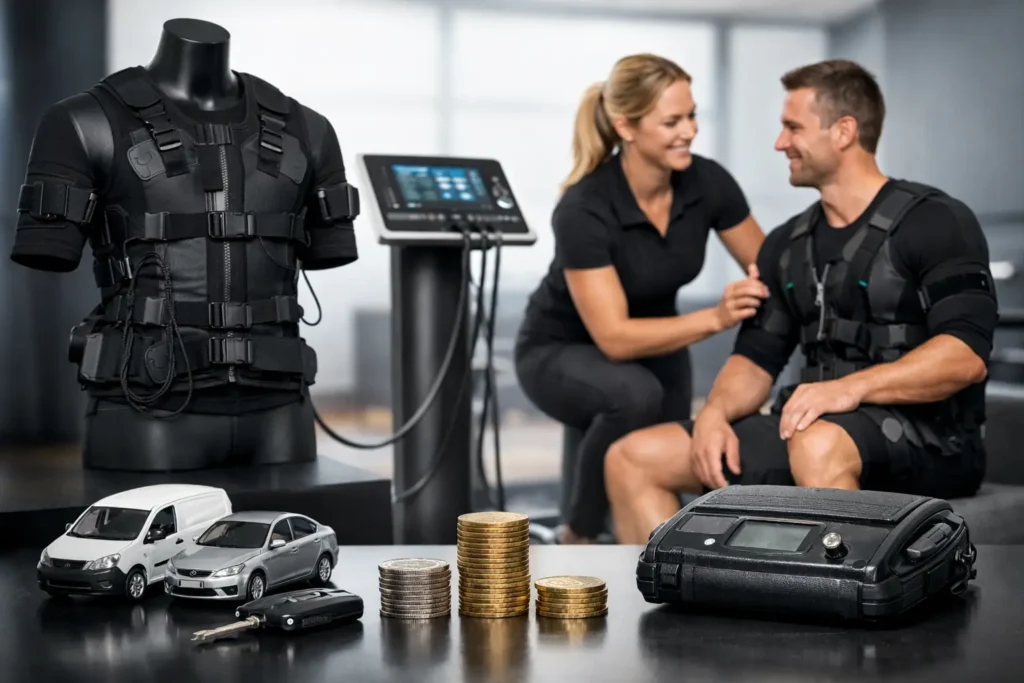
A commercially ready EMS setup may also require suits or vests, control hardware, chargers, accessories, replacement components, onboarding, operator training, warranty coverage, and a plan for maintenance. If these elements are not considered early, an apparently lower-cost offer can create unplanned costs after launch.
Ask every supplier to clarify what is included in the commercial package. You should know the number of usable client sets, whether training is included, how warranty claims are handled, the availability of spare parts, and what support is available if your team needs help during setup or early operations.
It also helps to calculate cost against capacity rather than looking only at a single figure. A system that lets you serve more clients reliably, maintain a professional schedule, and reduce downtime may provide stronger value even if its initial investment is higher.
Calculate the payback period realistically
A useful payback calculation begins with conservative assumptions. Estimate your expected weekly session volume, average session price, trainer costs, local overhead, cleaning and consumable expenses, and financing payment where applicable. Then test the model at a modest occupancy level, not only at full capacity.
For example, a mobile operator may need fewer weekly appointments to cover equipment costs because overhead is lower. A studio may have greater fixed costs but more available booking slots and opportunities for packages or memberships. Neither model is automatically better. The numbers depend on your market and execution.
EMS Sale: When Direct Purchase Makes Sense
An EMS sale is generally the strongest fit for operators with available capital and a clear, validated plan. Direct ownership gives you full control over the asset and removes ongoing rental payments. It can be particularly suitable for established gyms, clinic managers, and investors opening a planned EMS location.
Buying can also simplify long-range planning. Once the equipment is paid for, your financial focus shifts toward client acquisition, staff utilization, service quality, and replacement planning. For a business that expects stable, long-term demand, this can be a practical route.
The trade-off is upfront exposure. Capital tied up in equipment cannot be used for fit-out, marketing, payroll, or opening reserves. This is why direct purchase should not drain the working capital needed to launch professionally. Owning an EMS system is valuable, but a funded go-to-market plan is often more valuable during the first months.
EMS Rental for a Faster, Lower-Commitment Launch
EMS rental gives new operators a way to start with less capital tied up in equipment. It is a practical option for trainers launching mobile services, entrepreneurs testing a local market, and businesses that need to add capacity without making an immediate large purchase.
Rental can reduce the pressure of getting every decision perfect before your first client session. It allows you to build operational experience, refine your offer, and see which client segment responds best. A trainer may discover that corporate wellness sessions create the strongest demand. A boutique studio may find that premium 1-to-1 appointments outperform group-oriented formats.
However, rental should be evaluated as a business tool, not simply as the lowest monthly payment. Review the minimum term, included service, condition requirements, replacement process, and whether a transition to ownership is available. A flexible rental structure is useful when it supports a defined next step rather than leaving the business in permanent uncertainty.
EMS Leasing and Rent-to-Own Options
EMS leasing can balance access and ownership for businesses that want to protect cash flow while building a long-term asset. It is often suitable for operators who have already validated demand but prefer to spread the investment over time.
A rent-to-own structure may be especially useful during the move from independent trainer to studio operator. Instead of waiting until all capital is available, the business can begin serving clients while making planned payments from operating revenue. This approach requires disciplined forecasting. The payment must remain comfortable during slower months, not just during a strong launch period.
Compare the full term, total cost, ownership conditions, service coverage, and early settlement terms. The best arrangement is one that leaves enough room in your budget for sales activity, staff development, and client retention. Equipment finance should support growth, not restrict it.
Used EMS: Value Opportunity or Operational Risk?
Used EMS equipment can be a valid option, but it requires more due diligence than a new system. The purchase price may be lower, yet the real value depends on condition, remaining service life, hygiene management, software or controller compatibility, and the availability of replacement parts.
For any used EMS system, verify its history. Ask how it was operated, how many client sets are included, whether batteries and chargers have been tested, and whether the unit can be serviced. Confirm that manuals, training access, and appropriate after-sales support are available. Equipment without a clear maintenance path can become a costly interruption to your schedule.
Used systems are often most appropriate for experienced operators who understand their technical and commercial requirements. For a first-time EMS entrepreneur, a supported new, rental, or rent-to-own solution may reduce risk and shorten the path to a confident launch.
Choose the Model That Protects Your Momentum
There is no single best way to enter the EMS market. Purchase works well when capital and demand are established. Rental supports speed and flexibility. Leasing or rent-to-own can preserve cash while building toward ownership. Used EMS can lower entry cost when condition and support are fully verified.
EMS Leader helps operators evaluate these options in the context of their actual business model, from mobile 1-to-1 services to scalable studios and premium wireless concepts. The goal is not to push a payment model. It is to choose a setup that matches your client capacity, investment level, and plan for growth.
Make the decision from a business case, not a product brochure. When your equipment, financing, training, and commercial plan work together, you can spend less time second-guessing the investment and more time building a service clients return to.