

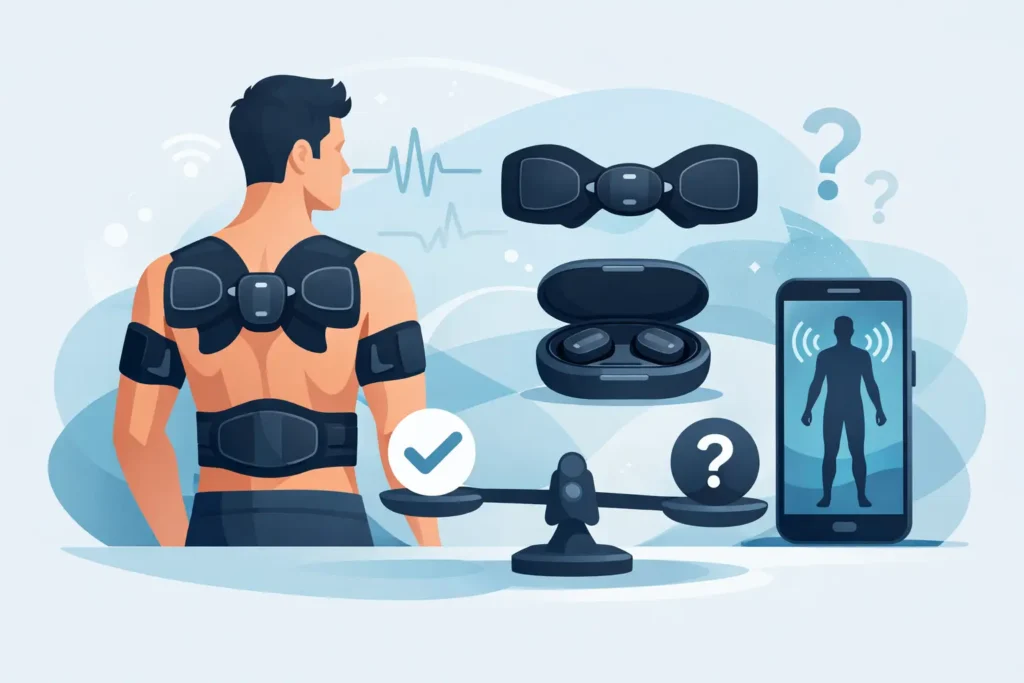
Premium EMS is often sold on aesthetics. That is not the real decision point. If you are evaluating a dry wireless EMS system, the question is whether it gives your business stronger pricing power, smoother delivery, and a model your clients will actually pay more for.
For some operators, the answer is yes – clearly yes. For others, a dry wireless setup looks attractive on paper but creates a longer payback period than a wired or wet system would. The right choice depends less on the technology itself and more on your positioning, session format, and target customer.
What a dry wireless EMS system really changes
A dry wireless EMS system removes two common frictions in the EMS experience: cables and moisture-based preparation. That changes more than comfort. It changes how premium the service feels, how quickly you can turn sessions, and where you can deliver them.
From a business standpoint, those are not cosmetic details. They affect session flow, staffing, setup time, brand perception, and the rates you can command. In boutique wellness, luxury fitness, concierge personal training, and VIP recovery concepts, presentation matters. Clients paying premium prices usually notice every operational detail, from how fast they get started to how unrestricted they feel during movement.
Wireless operation also changes the coaching environment. Trainers can move more freely around the client, demonstrate exercises without cable management issues, and run sessions in spaces where a traditional setup may feel too clinical or too equipment-heavy. If your offer depends on convenience, elegance, and discretion, that matters.
Where this system fits best
Not every EMS business needs to start with the highest-end format. A dry wireless EMS system is usually best aligned with concepts that compete on exclusivity, comfort, and service quality rather than simple session volume.
The strongest fit is often boutique private studios, personal training businesses serving high-income clients, wellness clubs, recovery lounges, premium apartment gyms, hospitality environments, and executive or at-home coaching models. In these segments, clients are not just buying muscle stimulation. They are buying a better session experience and a brand they can trust at a higher price point.
If your local market is price-sensitive and your growth plan depends on maximizing throughput at mid-range rates, a studio-focused setup may offer a faster return. If your strategy is fewer clients, higher ticket value, and stronger differentiation, dry wireless can be the smarter commercial move.
The business case for a dry wireless EMS system
The value of a dry wireless EMS system is usually tied to four business levers: pricing, convenience, positioning, and mobility.
Pricing is the most obvious. Premium EMS formats support premium session rates, especially when sold inside a broader service package that may include personal training, body composition tracking, recovery, longevity, or private coaching. If your market already supports high-end wellness spending, the system can help justify a higher perceived value.
Convenience is the second lever. Reduced prep complexity can improve session flow and create a more polished client journey. That helps with retention, referrals, and trainer efficiency. A service that feels easier to book and easier to complete tends to sell better over time.
Positioning is where many operators either win or miss the opportunity. Dry wireless EMS should not be marketed as just a technical upgrade. It should be positioned as a premium service format. That includes how you price it, where you offer it, how your staff present it, and what type of client outcome you build around it.
Mobility matters too. Wireless systems are not only for fixed studios. They can support premium in-home sessions, corporate executive wellness, hospitality partnerships, and pop-up concepts where a clean setup matters. That can open revenue channels that are harder to serve with more cumbersome equipment.
Trade-offs you should be honest about
A premium system can improve the client experience, but it does not remove the need for commercial discipline. The biggest mistake is assuming that a higher-end device automatically creates a higher-end business.
Your acquisition strategy still has to work. If you do not have access to a client base willing to pay premium rates, a dry wireless EMS system may stretch your payback period. The equipment can be excellent and still be the wrong fit for your launch stage.
There is also an operational trade-off. Premium services often require stronger brand presentation, better onboarding, more polished sales conversations, and tighter service standards. A luxury-priced offer is less forgiving than a volume-based one. Clients expect consistency.
You should also consider trainer capability. High-end EMS delivery depends on more than the hardware. Coaches need to understand session design, client communication, contraindications, and how to manage the experience with confidence. If training and support are weak, premium positioning starts to break down quickly.
Comparing dry wireless to other EMS business models
For first-time operators, the real question is usually not whether dry wireless is good. It is whether it is the best first move.
A mobile EMS model often requires lower initial investment and can be a faster entry point for solo trainers testing demand. A studio EMS model may be better for operators focused on repeatable throughput, multiple trainers, and a broader member base. A dry wireless EMS system sits higher on the market ladder. It is typically more suitable when you want to build a differentiated premium offer from day one or upgrade an existing business with a higher-value service tier.
That means the decision should be based on your business model, not just your product preference. If your main goal is to enter the market with the lowest risk, another format may be more practical first. If your goal is to stand out in a crowded premium market, dry wireless can be the right lead offer.
Questions to ask before you invest
The operators who make good EMS decisions usually ask commercial questions before technical ones.
Start with your client profile. Are you targeting busy professionals, luxury wellness customers, rehab-adjacent clients, or general fitness members? Then look at your delivery environment. Will you operate from a boutique studio, travel to homes, partner with clinics, or offer services inside hospitality or residential spaces?
Next, review your pricing structure. Can your market support premium single sessions, monthly memberships, or package-based sales that reflect the value of a dry wireless format? If not, the system may still be viable, but your offer design will need more work.
You should also evaluate capital strategy. Buying outright is not always the best move. Rental and rent-to-own models can lower entry friction, preserve cash flow, and let you validate demand before committing to a full asset purchase. For many operators, that flexibility is part of the business case, not a side detail.
Finally, assess the support behind the system. Hardware without onboarding, setup guidance, commercial planning, spare parts access, and after-sales support creates risk. Businesses do not scale on equipment alone. They scale on structure.
Why support matters as much as the system
A dry wireless EMS system can help you launch a stronger concept, but speed to revenue usually depends on what surrounds the device. That includes trainer education, operational setup, pricing logic, financing options, and a realistic growth path.
This is where many providers fall short. They sell a machine and leave the operator to solve everything else. That works for experienced EMS businesses with established systems. It is a poor model for most new entrants and even for many expanding operators.
A partner-led approach reduces expensive mistakes. It helps you choose the right commercial model, estimate payback realistically, align your equipment decision with your target segment, and launch with fewer gaps. That is especially important if your offer is positioned at the premium end, where inconsistency costs more.
EMS Leader is built around that logic. The equipment matters, but the bigger advantage is having a structured path into the market with setup support, training, financing flexibility, and business guidance tied to the model you actually want to run.
So, is it worth it?
A dry wireless EMS system is worth it when premium positioning is central to your business, not added as an afterthought. It works best when you have a clear customer profile, a pricing model that protects margins, and a delivery format that turns convenience and presentation into revenue.
If you are launching into a value-driven market, testing demand with limited capital, or prioritizing volume over exclusivity, another EMS setup may give you a better first return. There is no universal best system. There is only the right system for the business you are building.
That is the decision to make carefully – because the best EMS investment is not the one with the most features, but the one that helps you sell faster, deliver better, and grow with less friction.