
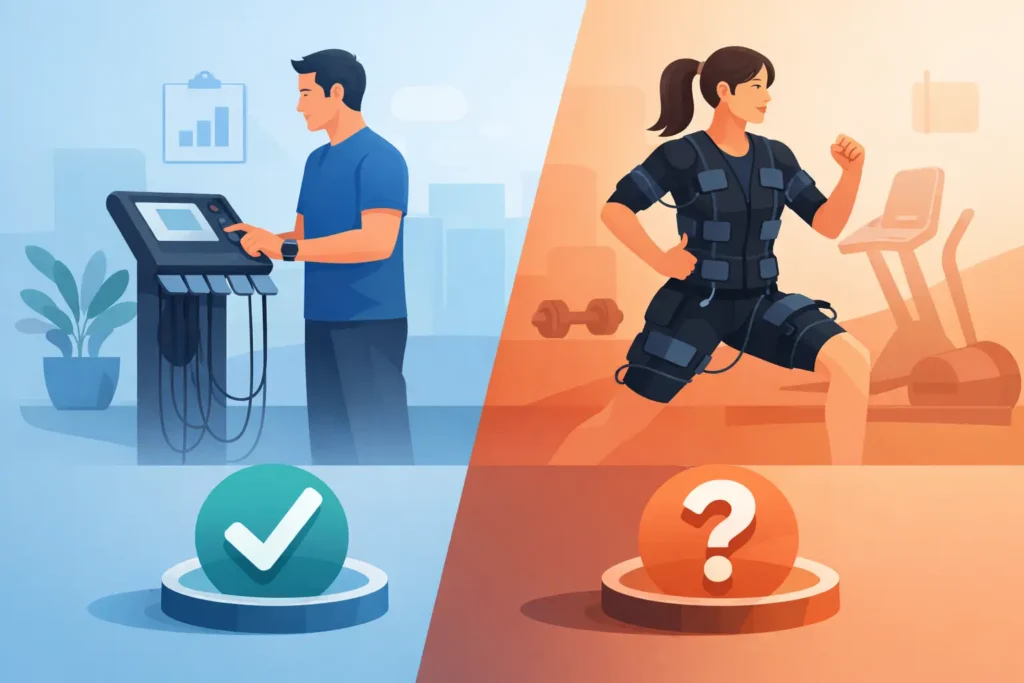
A trainer with demand, a growing client list, and no interest in tying up cash in equipment is usually asking the right question: is EMS rental for trainers the fastest path to revenue, or just a short-term fix that becomes expensive later?
For many operators, rental is not a compromise. It is a commercial decision. It lets you test pricing, validate demand, and start selling sessions before making a full capital commitment. But that only works when the rental model is built for business use, not just equipment access.
Why EMS rental for trainers is gaining traction
The appeal is simple. Rental lowers the barrier to entry while keeping your launch timeline short. Instead of spending heavily upfront, you can preserve capital for the parts of the business that actually drive growth – client acquisition, branding, local promotion, space, and staff.
That matters even more for independent trainers and small operators. A good trainer may already know how to sell transformation, retention, and premium service. What often slows the launch is not confidence in coaching. It is uncertainty around investment size, system setup, and operational support.
Rental removes part of that friction. It gives trainers a way to start with a defined monthly cost, clearer cash flow planning, and less exposure if they are still choosing between mobile service, a fixed studio, or a hybrid model.
Rental is not just about affordability
The wrong way to evaluate rental is to compare it only to the sticker price of buying equipment. The better question is what the model allows you to do in the first 90 to 180 days.
If rental helps you launch faster, sign clients sooner, and avoid delays caused by financing or procurement, it can improve payback even if the long-term cost is higher than direct purchase. Speed matters. So does support.
That is why serious trainers should look beyond the hardware. A strong EMS rental offer should include onboarding, user training, technical guidance, warranty coverage, and access to spare parts or replacement support. If those pieces are missing, the lower entry cost can quickly turn into lost sessions and avoidable downtime.
When EMS rental makes the most sense
Rental is often the best fit for trainers in three situations.
First, it works well for solo operators launching mobile EMS. If you are training clients at home, in offices, or inside partner facilities, mobility and low startup cost usually matter more than asset ownership on day one. Your business model depends on speed, flexibility, and keeping overhead lean.
Second, rental makes sense for trainers testing a local market. If you know there is interest in premium personal training but are not yet sure how EMS will be positioned, rental gives you room to validate demand. You can test session pricing, package structure, and client response before scaling.
Third, it can help trainers adding EMS as a new revenue stream inside an existing business. A personal training studio, wellness center, recovery concept, or clinic may want to introduce EMS without a full equipment purchase upfront. Rental creates a lower-risk entry point while the team builds utilization.
When rental may not be the best option
Rental is not always the right answer. If you already have proven demand, strong cash reserves, and a clear scaling plan, buying can produce better long-term margins. The same applies if you are opening a multi-coach studio and expect high session volume quickly. In that case, ownership may make more financial sense over time.
There is also a branding consideration. Some premium operators want a very specific equipment configuration, service environment, and long-term asset plan. If your model is built around a flagship location or investor-backed expansion, rental may feel too temporary unless it includes a rent-to-own path.
This is where business model clarity matters more than product enthusiasm. The best decision depends on client volume, pricing power, launch timeline, and how much operational certainty you already have.
What trainers should evaluate before signing a rental agreement
The monthly payment is only one line on the page. Trainers should evaluate the full commercial picture.
Start with client capacity. How many sessions per week can you realistically deliver with your schedule, market, and location model? A mobile trainer may value flexibility over throughput. A studio operator may need a setup that supports multiple coaches and a higher daily client count.
Then look at pricing. If your local market supports premium personal training, EMS can often be positioned at a higher rate than conventional sessions. But your rental model has to leave enough margin after payment, travel, staffing, and marketing costs. A cheap rental that limits service quality is not a good deal.
Support is the next factor. This is where many offers separate quickly. Trainers should ask who handles onboarding, whether business setup guidance is included, how technical issues are resolved, and what happens if a component fails. If downtime means canceled sessions, support has direct revenue value.
Finally, consider your upgrade path. Can you move from mobile to studio? Can you transition from rental to ownership? Can the provider support different business models as you grow? A rental partner should not trap you in your starting point.
Mobile, studio, or premium: choose the right EMS model
Not every trainer needs the same EMS setup. That is where many buying decisions go wrong.
For mobile operators, portability and low investment usually come first. You need equipment that is practical to transport, quick to deploy, and commercially viable for one-to-one or small-format training. Your revenue model depends on convenience and premium service delivered outside a fixed facility.
For studio-based trainers, the priorities shift. Capacity, workflow, and team use matter more. You may need a setup that supports more structured scheduling, higher utilization, and smoother handoff across coaches. In that environment, the real issue is not just whether you can deliver EMS sessions. It is whether the setup can support a repeatable business.
For premium wellness or boutique concepts, presentation and client experience become part of the offer. Higher-end operators often want dry wireless EMS solutions that fit luxury, longevity, or VIP positioning. In those cases, rental can still work, but the provider needs to understand the commercial demands of premium pricing and brand perception.
The real ROI question
Trainers often ask whether rental is profitable. The more useful question is how quickly the rental can be covered by booked sessions.
If your pricing is strong and your schedule fills early, a rental model can become self-funded quickly. That is one reason many first-time operators prefer it. They can match fixed monthly cost against active revenue without taking on a large upfront purchase.
But ROI depends on execution. A trainer with a strong sales process, clear positioning, and high retention will usually outperform a trainer who buys equipment outright but lacks a launch strategy. Equipment matters, but commercialization matters more.
That is why business support should be part of the decision. Providers that help with setup, planning, and model selection reduce the gap between owning equipment and building a working EMS business. For trainers entering the category for the first time, that can be the difference between a slow start and early traction.
How to choose an EMS rental partner
A credible partner should be able to discuss more than features. They should be able to talk about launch speed, revenue model, utilization, and what kind of operator the setup is actually designed for.
Ask direct questions. Is the rental offer built for solo mobile trainers, studios, or premium wellness concepts? What support is included after delivery? Is there guidance on commercialization, not just equipment use? Can the agreement evolve if your business grows?
This is where a company like EMS Leader stands out. The strongest rental providers do not treat trainers like one-time buyers. They work as business partners with financing flexibility, setup support, training, and a path forward as the operation matures.
A practical decision, not a permanent label
Some trainers hesitate because rental feels like a beginner move. That is the wrong lens. Rental is often the most practical way to protect capital, validate the market, and launch with support. In many cases, it is the more strategic choice, not the smaller one.
The key is to choose a model that fits your stage. If you need fast entry, lower risk, and a clearer path to first revenue, rental deserves serious consideration. If you already have demand locked in and want maximum long-term margin, ownership may be the better fit.
The smart move is not choosing the cheapest path. It is choosing the setup that gives your EMS business the best chance to start strong and keep growing.