

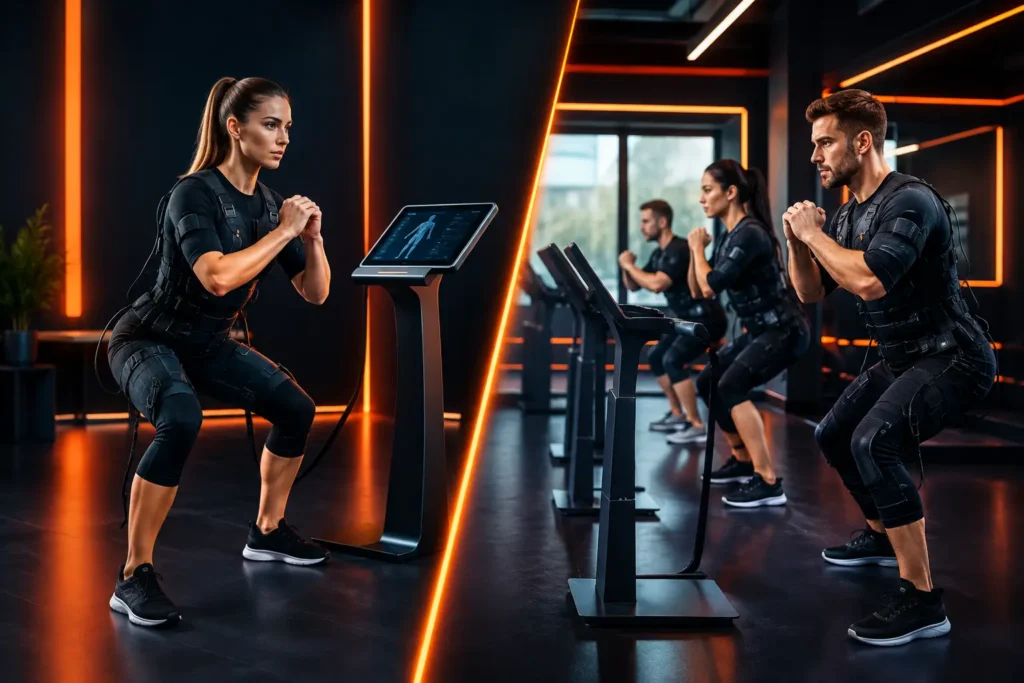
A busy 6 p.m. schedule can expose the limits of an EMS business model quickly. If clients are waiting for appointments, a single device may be restricting growth. If your calendar still has open slots, adding stations too early can create avoidable overhead. The decision between single versus multi station EMS is not about buying the largest setup available. It is about matching capacity, investment, and operating complexity to the business you can realistically build.
For trainers, studio owners, clinics, and wellness entrepreneurs, the right choice affects launch speed, monthly costs, staffing, client experience, and the path to profitability. A single station creates a focused entry point. A multi-station setup creates room for volume, team-based delivery, and a stronger studio model. Both can be commercially sound when the business plan supports them.
Single Versus Multi Station EMS: The Core Difference
A single-station EMS setup is built around one active training position. It is typically suited to one-to-one sessions, mobile EMS services, personal training integration, and early-stage studio concepts. The operator can work directly with each client, maintain close service quality, and keep the initial investment and space requirements controlled.
A multi-station EMS setup supports several active clients or sessions within the same operating window. Depending on the system and format, this may mean small-group EMS training, multiple trainers serving clients at once, or a studio designed for higher throughput. It is a capacity decision first, but it also changes the business from owner-operated delivery to a more structured operation.
| Decision factor | Single-station EMS | Multi-station EMS | |—|—|—| | Initial investment | Lower and easier to phase | Higher, with greater growth capacity | | Client capacity | Best for one-to-one delivery | Supports simultaneous sessions or multiple trainers | | Space requirement | Minimal, including mobile use | Dedicated studio space is usually needed | | Staffing | Can be owner-operated | Often benefits from trained staff and scheduling systems | | Revenue model | Premium personal service | Higher volume, packages, and small-group formats | | Operational complexity | Simple to launch and manage | Requires stronger processes and utilization planning |
The table does not make one option universally better. It shows why the wrong capacity level can slow progress. A multi-station studio with weak client acquisition will carry unnecessary fixed costs. A fully booked solo operator may lose qualified leads because one station cannot meet demand.
When a Single Station Is the Smarter Commercial Start
A single station is often the strongest choice when speed, flexibility, and controlled risk matter more than immediate scale. It allows an operator to validate local demand, refine the service offer, and establish a client base before committing to a larger location or team.
This model fits personal trainers who want to add EMS as a premium service without leaving their existing business behind. It also works well for mobile operators serving clients at home, at partner gyms, in hotels, or in corporate wellness settings. For a clinic or wellness center, one station can be an effective way to introduce EMS as an additional appointment-based service without redesigning the entire facility.
The commercial advantage is focus. With one station, every session can be carefully delivered, and the client relationship often becomes a major differentiator. Operators can position the service around time efficiency, coaching quality, privacy, and personalized programming rather than competing on volume.
That said, a single station needs disciplined scheduling. Since capacity is limited, cancellations and gaps in the calendar have a direct impact on revenue. A clear session policy, recurring packages, and a reliable client follow-up process matter more when each appointment slot is valuable.
Single station works best when you have
A single-station model is usually a good fit if you are launching independently, testing a new market, adding EMS to an established personal training service, or operating in locations where mobility is an advantage. It is also practical when your ideal client values private coaching and is willing to book consistent recurring appointments.
The goal should not be to stay small by default. The goal is to build utilization first. When your available peak-time sessions are consistently booked and prospective clients are facing limited availability, you have evidence that expansion may be commercially justified.
When Multi-Station EMS Creates More Value
A multi-station EMS configuration becomes attractive when demand, location, and operating capability are already aligned. It enables a business to serve more clients per hour and gives the owner more ways to structure offers, including paired sessions, small-group formats, memberships, and premium studio packages.
For gym owners, a multi-station EMS zone can increase the value of existing floor space. For dedicated studios, it creates the operating foundation for a high-throughput schedule. For boutique wellness concepts, multiple stations can support a polished experience where clients move through planned appointments without relying entirely on the founder’s personal availability.
The important distinction is that more stations do not automatically produce more revenue. Utilization produces revenue. A four-station setup with only one active client for most sessions may have the same sales outcome as a single station, but with greater equipment, rent, staffing, and management costs.
Multi-station EMS works best when the business has a credible plan to fill capacity. That plan may come from an existing gym membership base, a strong local referral network, corporate partnerships, a proven lead-generation system, or an established team of trainers. Without one of these demand sources, expansion should be phased carefully.
Multi-station operations need stronger systems
Once several clients or trainers are active at the same time, consistency becomes an operational priority. Staff need standardized onboarding, session protocols, safety procedures, equipment care routines, and client record processes. Scheduling also becomes more strategic because peak demand must be distributed efficiently across stations and team members.
This is where business support matters as much as hardware. EMS Leader works with operators on setup planning, training, financing options, and commercialization strategy because a multi-station business depends on more than device capacity. The operating model must be clear before the studio opens.
Compare Investment Against Utilization, Not Ambition
Many operators make this decision based on where they want the business to be in three years. Long-term ambition matters, but the first equipment decision should also reflect the next six to 12 months. Consider how many paid sessions you can realistically deliver each week, what hours your target clients prefer, and whether you will personally deliver sessions or hire from the start.
A practical way to assess the decision is to model conservative utilization. Estimate your available weekly appointment slots, then calculate revenue using a realistic percentage of booked capacity rather than a full calendar. Apply your expected operating costs, including rent, trainer compensation, insurance, marketing, cleaning, maintenance, and financing where relevant.
If a single station reaches healthy utilization quickly, adding capacity can be a logical next step. If a multi-station model still works financially at moderate utilization, it may be the better launch configuration, particularly for an established facility with built-in traffic. The numbers should support the decision, not simply the visual appeal of a larger studio.
Space, Staffing, and Client Experience
Space is more than square footage. A single station can operate in a compact private room or travel to the client. A multi-station format requires room for safe movement, changing areas where appropriate, reception flow, storage, and a professional environment that matches your market position.
Staffing is equally important. Owner-led single-station businesses can create a highly personal service, but they may have a revenue ceiling tied to the owner’s hours. Multi-station concepts can reduce that dependence over time, although hiring and training introduce new management responsibilities.
Client experience should guide both choices. A premium audience may prefer private appointments even if the business owns multiple stations. A results-focused gym audience may respond well to energetic paired or small-group sessions. The right format is the one your target market will book repeatedly, not the format that looks most impressive during launch week.
Build an Expansion Path, Not Just a Setup
The strongest EMS businesses treat equipment selection as part of a broader operating plan. Start with your target client, service format, available space, delivery capacity, and financing comfort level. Then select a configuration that gives you enough room to grow without forcing the business to carry capacity it cannot yet use.
A single station can be a deliberate launch platform, not a compromise. A multi-station studio can be a powerful growth vehicle, not an automatic upgrade. The better choice is the one that turns your current demand into repeatable appointments and gives your business a clear, manageable next move.